What is AI? A Beginner’s Guide
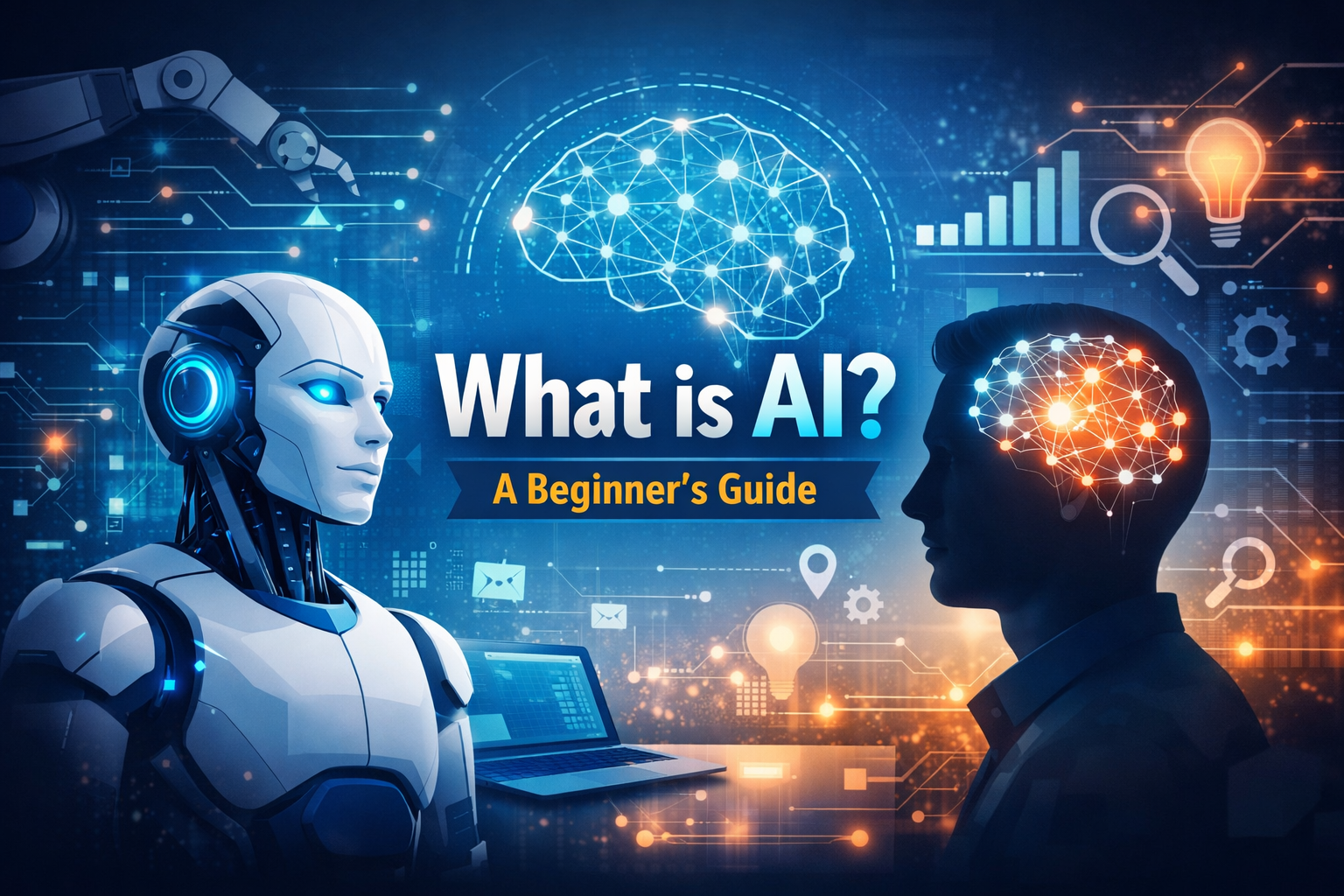
Today, in this article, we’ll provide information about AI (artificial intelligence). In this article, we’ll explain its types, functions, applications, advantages, and disadvantages. Even a beginner will learn everything about AI if they read this article.
Introduction: Why is AI Important?
AI will become increasingly important in the future. Even now, you can see that we knowingly or unknowingly use AI for many tasks, such as Google and Siri. We always seek information from AI before starting any task. Students also use AI to do their homework and solve questions.
What Does AI Mean?
The full form of AI is Artificial Intelligence. AI helps us humans complete tasks and seek advice. It has made our work much easier.
Tasks AI can perform include:
- Speech recognition
- Image and video analysis
- Decision-making
- Predicting outcomes
- Learning from data
A Simple Explanation for Beginners
How do we learn new skills?
- First, we observe the skill: we watch how others perform it.
- Then we practice it: we make mistakes, then observe them.
- Then we improve and correct our mistakes.
AI learns in a similar way, but it uses past data. It checks everything and then gives us an answer, which is why it’s very accurate.
How Does AI Work?
AI works in a few steps:
- Input Data: Every AI or machine needs commands such as text, images, or numbers.
- Algorithms and Models: AI uses its algorithms to analyze data, find patterns, and make predictions.
- Learning: AI gradually improves its performance by using machine learning.
- Output: Finally, AI makes its decision, which is highly accurate because it is made after taking all the information into account.
Example: AI in email filters uses past spam emails to detect and block new spam automatically.
Types of Artificial Intelligence
Based on Capabilities
- Narrow AI (Weak AI): It performs small tasks like Google Translate, Siri.
- General AI (Strong AI): It can perform tasks that a human can perform, but only performs theoretical tasks.
- Superintelligent AI: It can perform all kinds of tasks, but is much more helpful and accurate.
Based on Functionality
- Reactive Machines: This is extremely simple; it is installed for AI tasks (e.g., IBM Deep Blue).
- Limited Memory AI: This AI learns new things by using its past data (e.g., self-driving cars).
- Theory of Mind AI: This is a future AI that understands human emotions (research stage).
- Self-Aware AI: This is an AI that is no less than a human. This AI is completely conscious (conceptual).
Everyday Examples of AI
- Smartphones: Face scanning, voice recognition, Siri, Hey Google.
- Social Media: This AI gives us recommendations on what we can post in the future.
- Online Shopping: This AI analyzes our past searches and suggests new products.
- Healthcare: This AI provides workouts and diets to keep us healthy.
AI has simplified our tasks, reduced our stress, and enhanced the user experience.
Benefits of AI
- Makes quick decisions
- Available at all times
- Analyzes data from everywhere and provides results
- Explains well
- Increases the accuracy of any decision
Challenges and Limitations of AI
- Data Dependency: AI need a lot of data sets.
- Lack of Understanding: AI don’t understand other people’s feelings. AI don’t have emotions.
- Job Displacement: It is possible that in the future it may be replaced by humans.
- Privacy Concerns: It also analyzes personal data of us humans.
- High Costs: Developing AI solutions is expensive and complex.
AI and Ethics
Those who are responsible use the required addressing:
- Bias: It avoids any unfair decisions that occur due to biased data.
- Accountability: Discharging responsibility for any incident caused by an artificial act.
- Privacy: It protects user personal information from any misuse.
How to Get Started with AI (For Beginners)
- Learn Basics: Understand the Algorithm and Concepts.
- Math Foundations: Focus on some topics like Statistics, Probability and Linear Algebra.
- Use Beginner Tools: AI platforms with some minimal coding.
- Online Courses: Any platforms like Coursera, Udemy etc.
- Practice Projects: Create some AI applications like chatbot etc.
Keep Practicing.
The Future of AI
It is progressing at a rapid pace. In the future, it could do many things, such as:
- Smarter healthcare solutions
- Autonomous transportation
- Personalized education systems
- Advanced agricultural techniques
- Efficient energy management
Conclusion
Artificial intelligence is transforming our world. From improving everyday tasks to revolutionizing entire industries, AI is here to stay. Understanding the fundamental principles of AI, its applications, and ethical considerations will help beginners stay ahead in this technology-driven world.
AI is not just a technology – it’s a tool for augmenting human intelligence, improving efficiency, and creating new opportunities for learning and growth.
FAQs About AI
- What is AI in simple terms?
AI is the ability of machines to perform tasks that normally require human intelligence, such as learning, reasoning, and decision-making. - What are some common examples of AI?
Examples include voice assistants (Siri, Alexa), recommendation systems (Netflix, Amazon), self-driving cars, and chatbots. - What is the difference between AI and Machine Learning?
Machine Learning is a subset of AI that allows machines to learn from data and improve over time without explicit programming. - Is AI safe for humans?
AI is generally safe if used responsibly. Ethical AI practices and proper regulations are key to avoiding misuse. - Can beginners learn AI?
Yes, beginners can start with basic concepts, online courses, simple projects, and gradually advance to complex AI applications.